Rogue River Valley
Search Travel Guides
Oregon Maps
Oregon History
Pioneer Days
Oregon Cavemen
Touchdown Willie
Ox and Log Wagon
Dry Diggings
July Surprise
Gold Discovery
Decline of Mining
Mercury Mining
More Oregon History
Searching?
U.S. Maps
Telephone Directories
National Historic Trails
California Trail
Cherokee Trail
Lewis Clark Trail
Mormon Trail
Mormon Pioneer Trail
Old Spanish Trail
Pony Express Trail
Santa Fe Trail
Trail of Oregon
Trail of Tears
More National Trails
National Scenic Trails
Appalachian Trails
Pacific Crest Trail
Paiute ATV Trail
Klondike Gold Rush
More Scenic Trails
American Historic Trails
Applegate Trail
Bozeman Trail
Chisholm Trail
Dominguez - Escalante
Indian Trails
South Pass, Wyoming
Taos Trail
Three Island Crossing
More American Trails
California Travel Guides
California - Bay Areas
Oregon Travel Guides
AA Oregon
Grants Pass, Oregon
Medford, Oregon
Rogue River Valley
Southern Oregon
Utah Travel Guides
Beryl, Utah
Enterprise, Utah
Modena, Utah
New Castle, Utah
Salt Lake Valley, Utah
Salt Lake City, Utah
Personal Guides
See Me Thin - Dieting
Photographic Images
Give the Dogoody ABC's
U-2 - "Our eye in the sky"
Movies - Music DVD MP3
Diet Guides
|
Rogue River Valley - Oregon Travel Guide
Articles from the Historical Society in Josephine County Oregon
Ox Team and Log Wagon
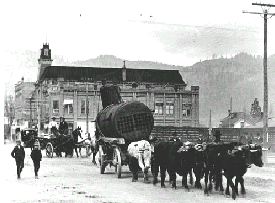
A Moment in Time
It was Monday the Sixth of April 1903, a beautiful spring day in Grants Pass. The hypnotic spell of the warm pine scented afternoon was interrupted by a man shouting about a six-ox team pulling an empty logging wagon across the Rogue River Bridge. A crowd of curious onlookers was soon falling in step behind the wagon.
Five mill men escorted the wagon as they proceeded to their destination. The Oxen and wagon were from the Nipper Johnston sawmill at Murphy and were going to the railroad depot to pick up a six ton boiler that had been unloaded several weeks ago from a railroad car to a special built cribbing of timbers beside the track.
The oxen plodded slowly down Sixth Street gaining an ever-increasing number of curious onlookers. There was even time to find a camera and record the historic event. Oxen had not been in use for hauling duty in town since the 1880's so when the mill hands arrived with the oxen and a logging cart, it raised quite a stir.
The prehistoric wagon had solid rear wheels made from the round block of a log banded with a steel rim. It took several hours to load the six-ton boiler on the wagon. When the oxen were hooked on, all the people in sight gathered open eyed to watch the start. Many of the old-timers were very familiar with oxen and just what they could or couldn't do, after all, many of them had crossed the plains with them.
There were a few that took bets that the cattle would not be able to budge the heavy six-ton load. The oxen walked off with their load calmly, deliberately without apparent effort and with an imperturbable and even contentious air. Bets were taken concerning the probable disastrous fate of the outfit before it reached its destination. Some argued the likely hood of it going through the Rogue River Bridge while others maintained that it would upset on the road to Murphy. One old gentleman in particular declared that it would tip over before it got to the first divide. He used to "pack" deer, he said, across this 1 divide, "Big fat Bucks" 30 years ago, 2 with his trousers pulled up, and he knew.
The boiler made it to its destination at the Nipper- Johnston mill site near the middle ford on the Applegate without any mishaps.
Its new 60 horsepower boiler would help boost production at the mill to 25, 000 feet per day. This sawmill was one of many satellite mills located in the sugar pine belts of Josephine county sawing lumber for the Sugar Pine Door and Lumber Company sash and door factory and mill in Grants Pass.
The photo shown is the actual recorded event of this moment in time, the spring of 1903.
1. The divide is known as Luther divide and is the highest point when traveling to Murphy on the Williams Highway. All creeks on the south side of the divide empty into the Applegate.
2. "With his trousers pulled up" was a common term used by loggers. When walking in the brush (timber) pant legs were usually cutoff above the boot tops, or hiked up so as not to get your cuffs caught on limbs etc.
By Michael Oaks
National Historic Trails - Information Center
Guides, Books, Games, and Reference
|
Products - Supplies
Inventory Liquidations !!
OwnMart.com
Memorabilia, games, books, movies, collectibles and more ...
Resources
Free diet samples and Diet Guide @ owndiet.com
Submit your site
|